
SEOUL / TOKYO /
PYONGYANG
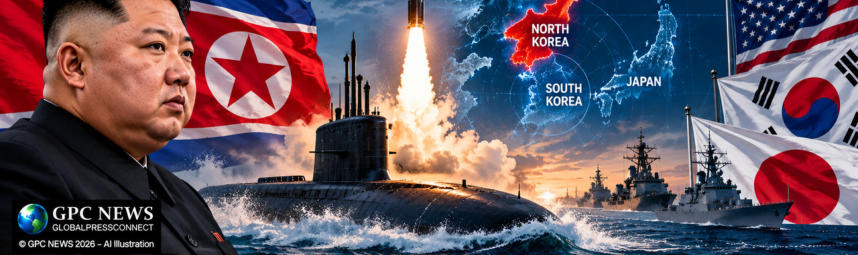
North Korea's continued development of ballistic missile technology remains one of the most serious security challenges confronting East Asia, placing renewed attention on military preparedness, regional alliances, and the possibility of miscalculation on the Korean Peninsula. Missile launches and weapons demonstrations by Pyongyang carry implications far beyond the borders of North and South Korea. They affect Japan's national security planning, the United States' military commitments in the Pacific, and the strategic

WOLRD
PEOPLE
TRUTH

ASIA - PACIFIC

OCTOBER 12, 2026 | GEOPOLITICAL ANALYSIS | BRUSSELS WASHINGTON LONDON KYIV MOSKOW BERLIN WARSAW | NATO www.gpc.news



North Korea's Ballistic Missile Program Raises
New Concerns Over Security in East Asia
SEOUL / TOKYO / PYONGYANG — North Korea's continued development of ballistic missile technology remains
one of the most serious security challenges confronting East Asia, placing renewed attention on military preparedness,
regional alliances, and the possibility of miscalculation on the Korean Peninsula.
The
Demilitarized
Zone
separating
the
two
countries
is
among
the
world's
most
heavily
fortified
borders.
Military
forces
on
both
sides
maintain
extensive
defensive
capabilities,
while
American
troops
stationed
in
South
Korea
form
an
important
component
of
Washington's
regional
security
commitments.
North
Korea
considers
its
military
capabilities
essential
to
regime
survival
and
deterrence
against
what
it
describes
as
hostile
foreign
powers.
South
Korea,
Japan,
and
the
United
States,
however,
regard
Pyongyang's
expanding
nuclear
and
missile
programs
as
a
direct
threat
to
regional stability.
These
competing
security
perceptions
have
contributed
to
repeated
cycles
of
military
demonstrations,
diplomatic
warnings, and heightened readiness.
North
Korea
has
invested
heavily
in
developing
ballistic
missiles
capable
of
carrying
different
types
of
payloads over varying distances.
Its
arsenal
includes
short-range
systems
designed
for
regional
military
operations,
intermediate-
range
weapons
capable
of
threatening more distant targets:


calculations of China and Russia.
The
growing
sophistication
of
North
Korea's
missile
capabilities
has
also
raised
concerns
about
the
effectiveness
of
international
sanctions
and
thects
for
renewed
diplomatic
negotiations.
prospects
for
renewed
diplomatic negotiations.
Although
individual
weapons
tests
differ
in
their
objectives
and
technical
characteristics,
their
cumulative effect is to
uncertainty
in
an
already
heavily
militarized region.
A Peninsula Still
Technically at
War
More
than
seven
decades
after
the
Korean
War
ended
in
an
armistice
in
July
1953,
North
and
South
Korea
remain
technically
at
war
because
no
comprehensive
peace
treaty
has
been concluded.




More than seven decades after the
Korean War ended in an armistice in
July 1953, North and South Korea
remain technically at war because no
comprehensive peace treaty has been
concluded.